Ember-resistant vents: are they worth it?
Ember-resistant vents: are they worth it?
Vents are the soft spot. A house can be a mile from the flame front and still burn from the inside out, because embers ride the wind ahead of the fire, find an unscreened vent, and drop into attic or crawlspace insulation where they smolder. NIST and IBHS research ties ember entry through vents and gaps in the building envelope to most home losses in the wildland-urban interface. So vent protection earns its place on almost every home. The real questions are which approach fits your home, and whether the upgrade is worth it. Here is the honest version, with the products we install and where each one makes sense.
The standard to look for
Before any brand, look for one thing: a listing to ASTM E2886. That is the test that simulates wind-driven embers hitting a vent and measures whether they get through, and it is the standard Oregon's R327 code and the national WUI codes point to. Traditional eighth-inch mesh and ordinary louvered vents do not pass it. A vent that carries an ASTM E2886 listing has been proven to do the job. Marketing language has not. We only install listed assemblies and screening.
Three ways to harden a vent
There is no single right answer. There are three proven approaches, and we install all of them, because the best choice depends on the opening, the home, and the budget.
1. Fine stainless ember mesh (the retrofit screen)
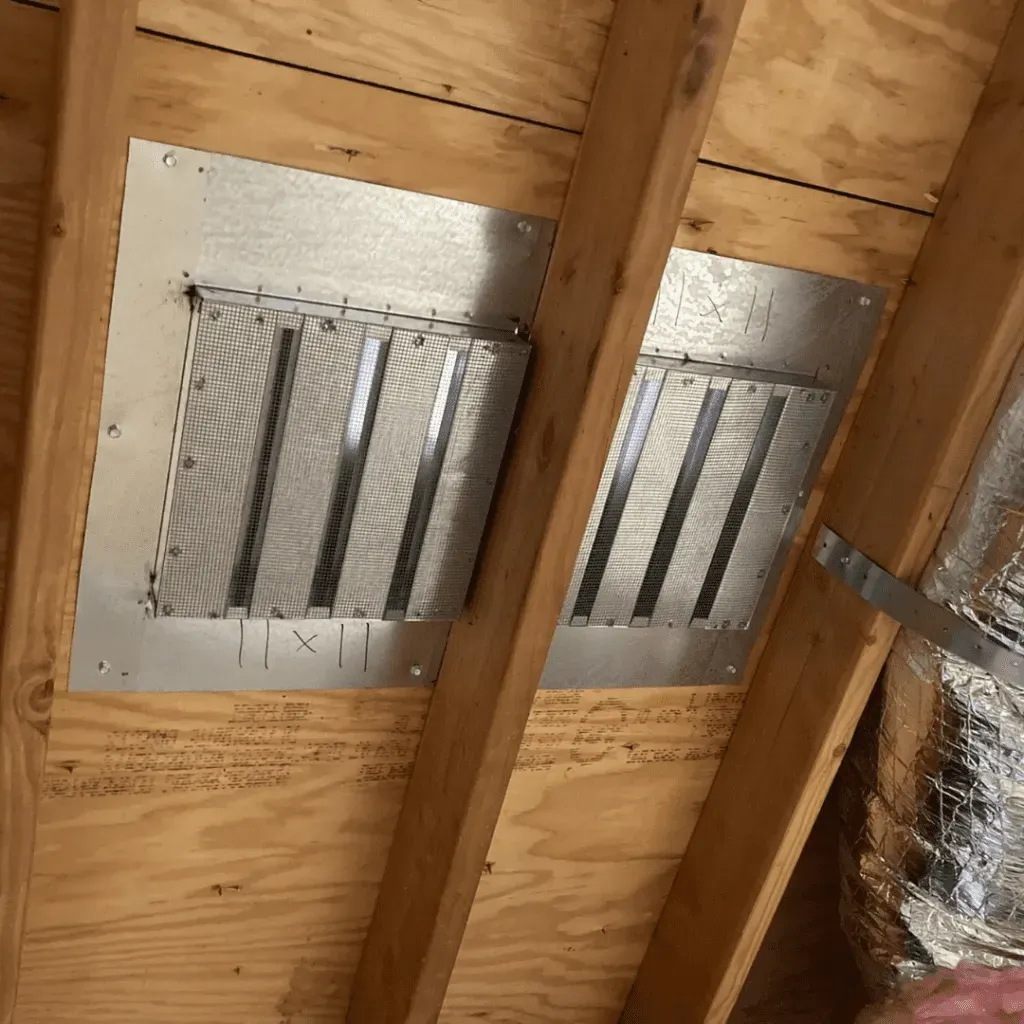
The simplest, lowest-cost option: fine stainless mesh fitted to existing vent openings so embers cannot pass. We install WildfireDefenseMesh (WDM), a 1/16-inch stainless ember mesh with about 62 percent open area, which keeps more airflow than typical fine mesh. It is fast, it fits most existing openings, and it is a large step up from eighth-inch mesh or a bare vent. The tradeoff: mesh screens embers, but it does not seal against flame or radiant heat the way a purpose-built vent does, and very fine mesh always gives up some airflow. Good budget protection, and the right call on plenty of openings.
2. Baffled, intumescent vents (purpose-built)
A full vent assembly engineered to stop embers, flame, and heat. We install BrandGuard, which combines an overlapping baffle maze that traps embers, a heat-activated intumescent strip that expands and seals the vent shut under extreme heat, and a noncombustible metal body. It is listed to ASTM E2886 and E2912 with a one-hour ASTM E119 fire rating, and the baffle design keeps close to the vent's rated airflow, so you do not trade away ventilation. BrandGuard also makes round bird-block eave vents that drop into existing eave holes, which is useful on older homes. This is the higher-protection, higher-cost end.
3. Louvered, intumescent vent assemblies
A louvered vent coated so it closes off airflow when it senses heat. We install Vulcan Vents, through MitigateNow, which are ASTM E2886 tested and ICC listed and come in the full range of openings: foundation, soffit, eave, gable, and dormer. Like the baffled vents, they protect against embers, flame, and radiant heat, and they suit both retrofits and new construction.
What they cost
Honest numbers. Standard vents run about $5 to $15 each. Purpose-built ember-resistant vents run roughly $65 to $380 depending on type and size. For a typical home with 10 to 15 vents, the materials upgrade plus labor can run a homeowner about $2000 to $3500. Mesh retrofits sit at the lower end and can run as low as $50 per vent, full assemblies at the higher end. Against the cost of an attic or crawlspace fire, it is one of the cheapest pieces of wildfire protection you can buy.
So, are they worth it?
For foundation, crawlspace, and soffit or eave vents, yes, almost always. Those are the openings where embers collect and where a fire is hardest to catch once it is inside. A listed ember-resistant vent there is money well spent.
For the choice between mesh and a full assembly, it comes down to budget and the home. On a tight budget, a clean stainless mesh retrofit is sound protection. Where you want the strongest protection and to preserve airflow, a baffled or louvered intumescent assembly is the better tool. We will walk your home and tell you which openings need what, instead of putting the same vent everywhere.
Where this fits with the code
If you are building new in Bend, Sisters, or unincorporated Deschutes County, Oregon's R327 code now requires ignition-resistant vents on new construction. See ourDeschutes County guidefor what else it covers. For an existing home, no one is forcing you, but your insurer increasingly cares, and vents are one of the highest-leverage retrofits on the house.
SafeHaven Fire Defenseis Central Oregon's GC-licensed wildfire hardening company (Oregon CCB#259806), serving Bend, Sisters, Redmond, Sunriver, Tumalo, La Pine, and Deschutes County.