What wildfire mitigation documentation actually needs to include
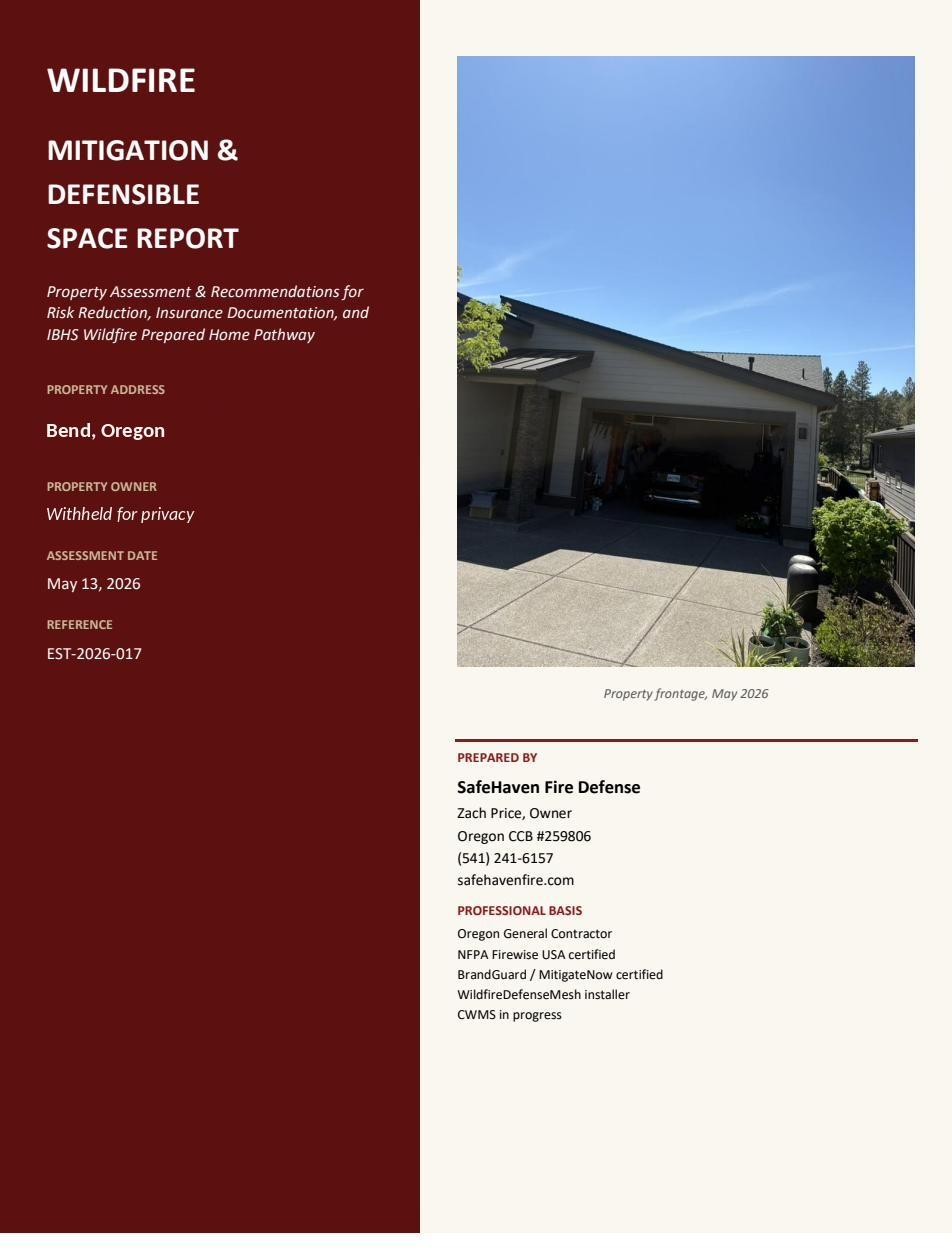
Most homeowners do not know what their insurance carrier needs to see, and most wildfire reports floating around do not have it. A photo of a cleared yard is not documentation. If you are trying to keep a policy, get reinstated, or qualify for a mitigation credit, the report has to be built to be read by an underwriter, not just by you. Here is what separates a report that holds up from one that gets ignored.
It starts from a recognized standard
A credible report maps your home against a published standard, not the inspector’s opinion. We build ours on the IBHS Wildfire Prepared Home framework and cite the underlying research: NFPA 1140, the current consolidated wildfire standard, along with NIST Technical Note 2205 and Oregon’s R327 code. When a document references the same standards the insurance industry funds and uses, an underwriter can actually place it.
It is specific, photographed, and located
Vague is useless. Every finding should name the location, the condition, and the action. “Vents” is not a finding. “Six unscreened foundation vents on the north and east elevations, replaced with ASTM E2886-listed ember-resistant vents” is. Each item needs a before condition, the work performed, and a photo tied to that exact spot on the house.
It separates what is done from what is recommended
A good report draws a clear line between completed mitigation and outstanding recommendations, phased by priority: Zone 0 first, then vents and gutters, then the wider defensible space. An underwriter wants to see both the current state and the plan to close the rest.
It uses the zones and the current standard names
Documentation should speak the standard’s language: the home ignition zones (0, 1, and 2), and the current IBHS tier names, Essential and Enhanced. A report still citing Base and Plus, or leaning on California’s Chapter 7A instead of Oregon’s R327, signals an inspector who is not current. For more on the levels, see our IBHS Wildfire Prepared Home guide.
It includes a maintenance section
This is not filler. Designations and credits assume ongoing upkeep, and a serious report says so plainly: annual Zone 0 inspection, no mulch in the first five feet, roof and gutters kept clear, vent screens checked, and nothing combustible stored against the house.
Why this sometimes matters more than the work itself
Here is the uncomfortable truth. You can do everything right and still lose the argument with your carrier if you cannot prove it. The work protects your home. The documentation protects your coverage. They are two different jobs, and most contractors only do the first.
That gap is the reason SafeHaven exists in the form it does: licensed structural work plus insurance-grade documentation under one roof. If a mitigation credit or a path back to coverage is your goal, the documentation is not the afterthought. It is the deliverable.
SafeHaven Fire Defense is Central Oregon’s GC-licensed wildfire hardening company (Oregon CCB #259806), serving Bend, Sisters, Redmond, Sunriver, Tumalo, La Pine, and Deschutes County. They are Certified Wildfire Mitigation Specialist (CWMS) and NFPA Firewise trained. Call (541) 241-6157 or email [email protected] to schedule an assessment.